Morning Watch, Out of Small Things and Signs & Reasons: A Podcast Network
Three AI-generated podcasts about the Church of Jesus Christ of Latter-day Saints, built on one pipeline. I designed the voices, the fact checking and the publishing system, and the episodes render on my own Mac.
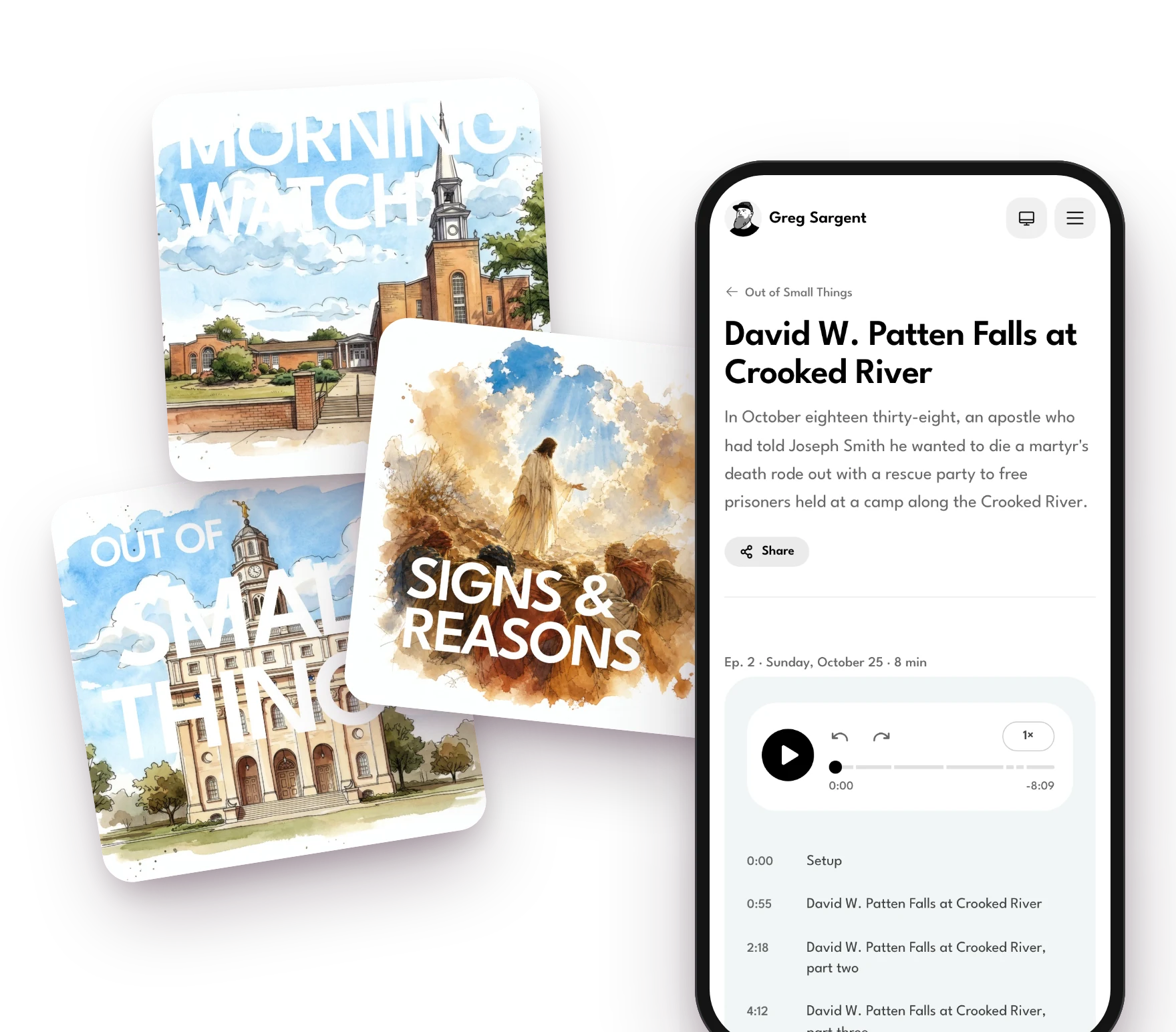
Three shows, five voices, one Mac
A daily newscast, a daily moment from Church history and a walk through one sign of the Second Coming once or twice a week. Each show has its own feed, cover, hymn and pages, and all three are written, voiced and published by the same system.
- Role
- Designer and engineer (solo)
- Shows
- Morning Watch
- Out of Small Things
- Signs & Reasons
- Timeline
- September to October 2026
- Stack
- React
- Vite
- Firebase
- Vercel
- Qwen3-TTS
- Claude CLI
- Suno
- 3Shows
- 5Designed voices
Overview
In September 2026 I built Morning Watch as a private nightly digest. A pipeline fetched new videos from a list of Church-related YouTube channels (the apostles' channels, BYU devotionals, a handful of independent creators), summarized each one into notes, and published them to a feed only I could see. It worked, and then I realized I was never going to sit down and read it. What I wanted was something to listen to on my drive, so I turned the notes into an audio newscast, and within a week it had public pages at /morning-watch, an RSS feed at /podcast.xml, and a submission to Apple Podcasts. Since then I have added Church News articles, the Church News podcast and the Newsroom as sources.
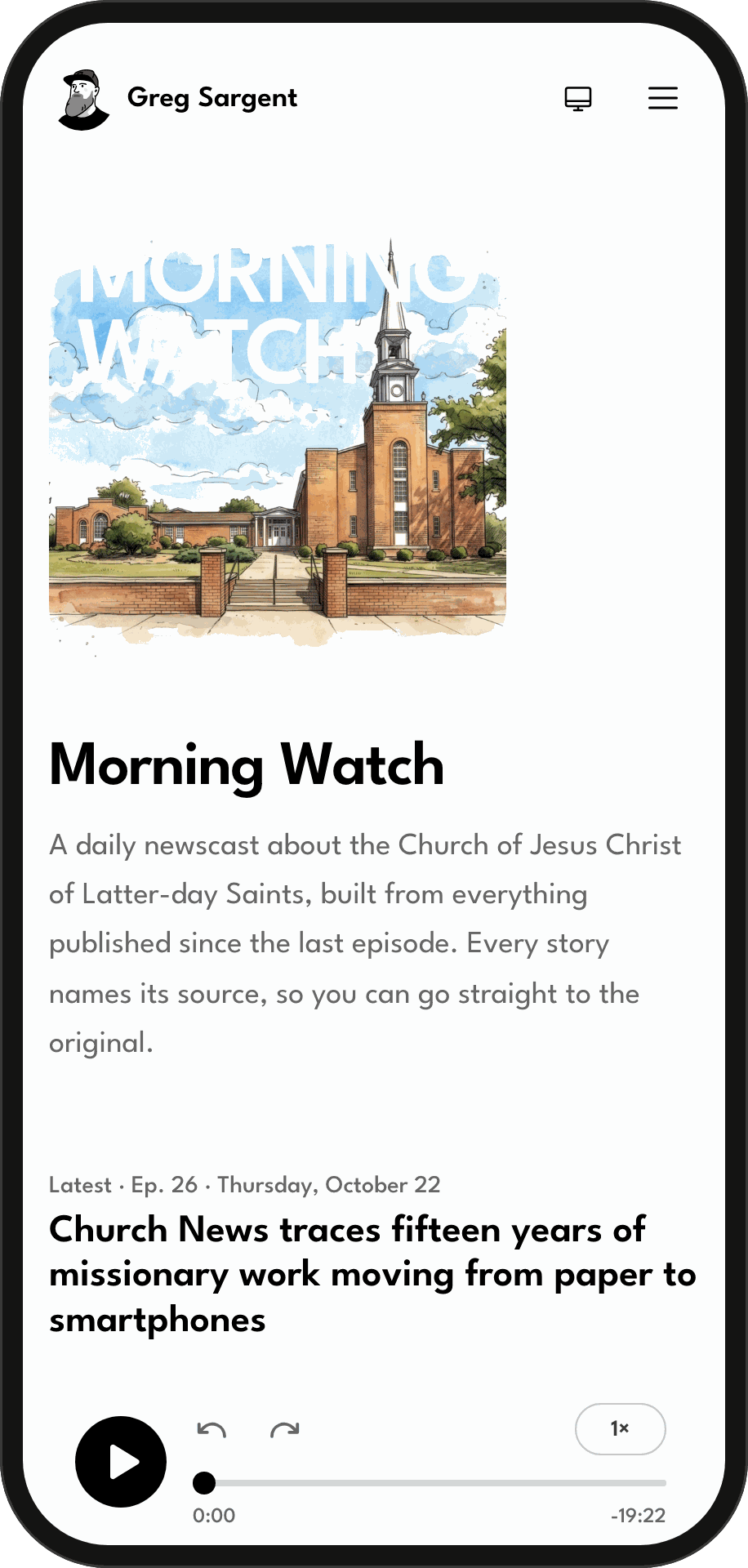
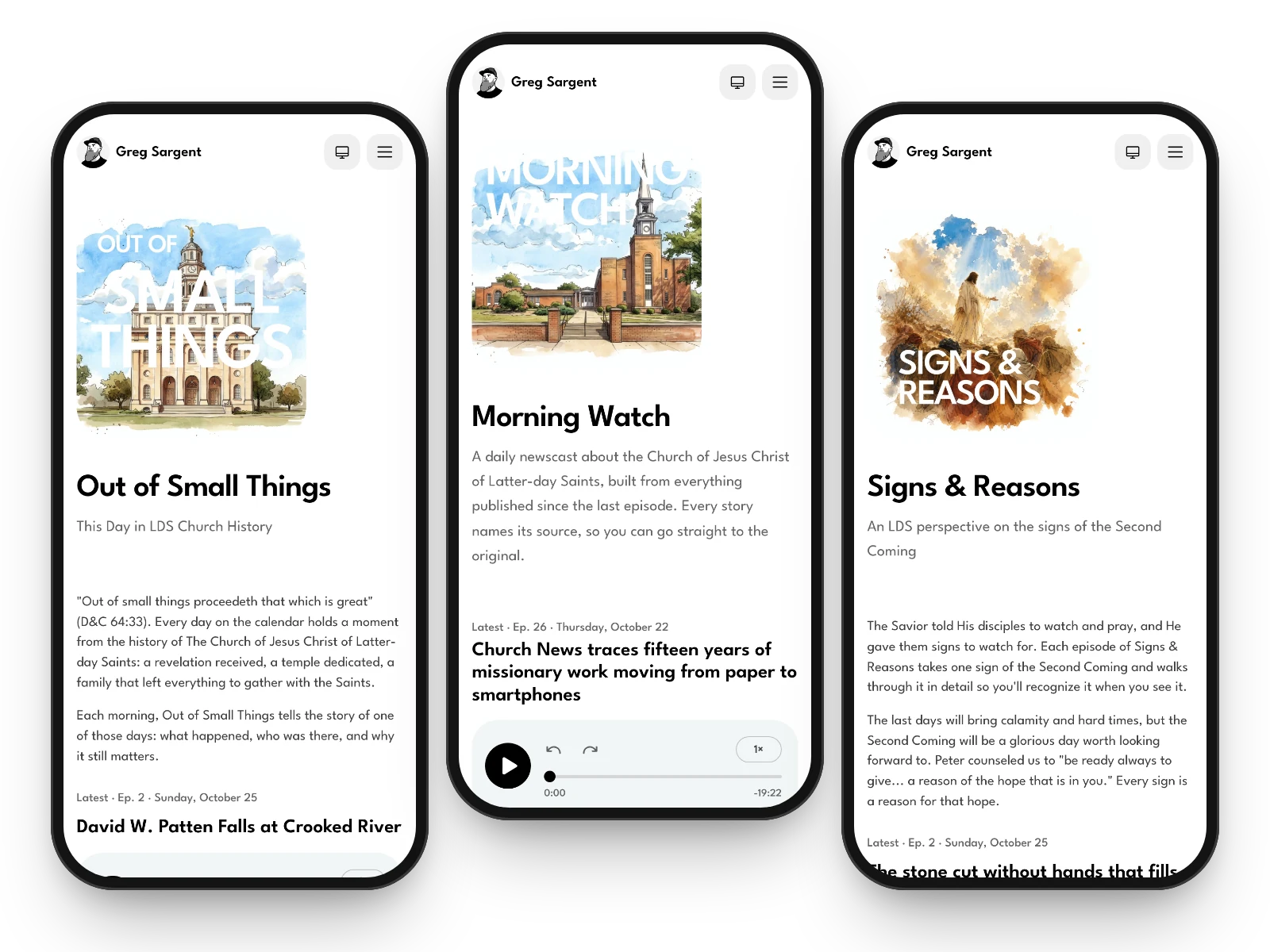
On October 24th two more shows launched alongside it, so there are now three: Morning Watch, a daily newscast; Out of Small Things, a daily look at one moment from Church history; and Signs & Reasons, a once-or-twice-a-week walk through one sign of the Second Coming. All three are AI-generated, none is an official publication of the Church, and all three run on one pipeline that I designed and built. This page is about how that pipeline works and why it is shaped the way it is.
Five voices who sound like a newsroom
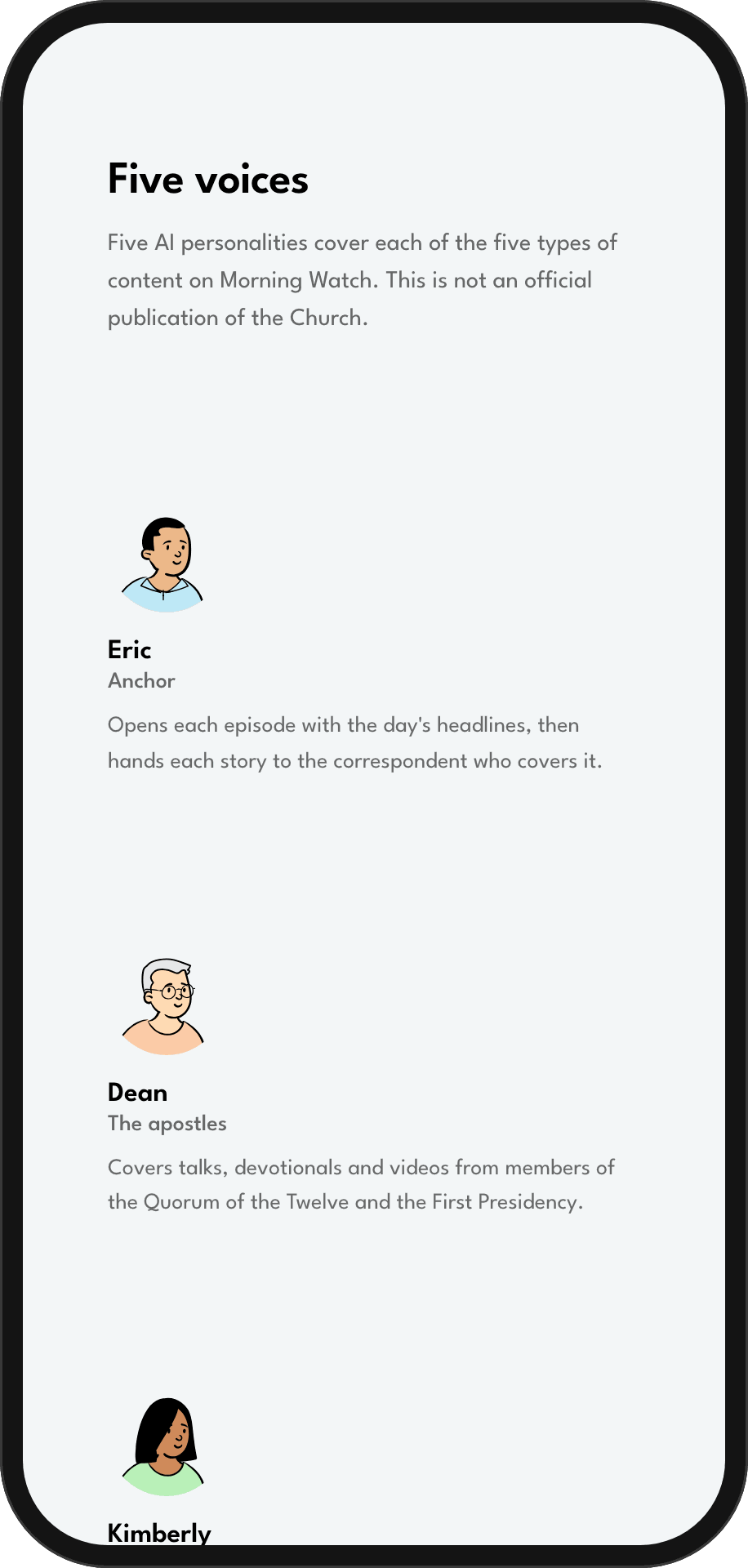
Morning Watch has five designed voices. Eric anchors. Dean covers the apostles, Kimberly covers the official Church channels, Ivanna covers independent commentary, and Jules closes with Come, Follow Me. For each story Eric names the channel and the person speaking, hands off to the right correspondent by name, the correspondent covers the story in one block and hands back, and every story names its source out loud, because a listener should always know whose words they are hearing.
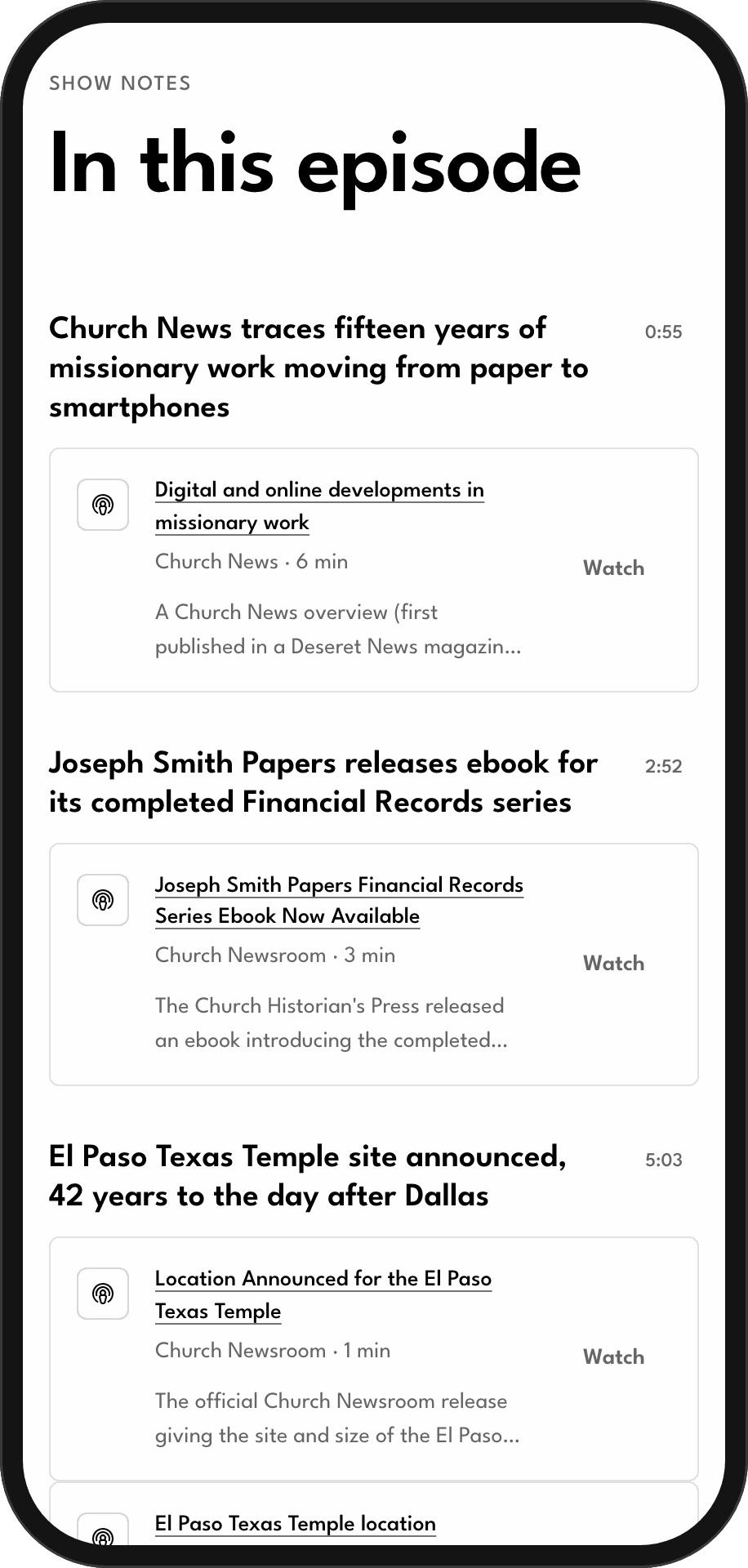
The show also reads as a neutral newscast, with no spoken hedging and no verdicts. The early scripts carried hedges like "reportedly," and on the air they sounded skeptical of the very people being quoted, which was the opposite of what I wanted, so I took them all out. Naming the source at the start of each story does the honest work, and the read stays flat.
The most useful design lesson came from the hardest question I asked of it, which was how to make it sound less like a machine reading. The obvious answer is to add "ums," laughs and other affect, and I held off on that, because copying the surface of natural speech is exactly what reads as a machine performing humanity. So I measured instead. The strongest signal turned out to be turn length: the median correspondent turn ran about 100 words, roughly 40 seconds of one voice without a break, and the longest ran 714 words, nearly five minutes. There was also a plain defect hiding in the audio: when the same speaker took two turns in a row, the build spliced a 0.45 second pause between them, and in the middle of someone's thought that doesn't sound like a beat, it sounds like a dropout. Every fix was structural. Back-to-back turns from the same speaker are merged into one, pauses vary with the shape of the turn, and each turn carries context from the one before it so the intonation continues across a handoff.
Voices that belong to nobody
The first voices came from ElevenLabs, which bills by the credit, and that quietly shapes a show: every extra episode is a budget decision. On October 22nd I ran a local text-to-speech bake-off and picked Qwen3-TTS. Chatterbox lost it, partly on small things like reading "BYU" as "bayou," which is a bad mistake for a show that says "BYU" constantly.
Every voice began as a written description of an age, a way of speaking and a pace. VoiceDesign turned each description into a reference clip, and every episode clones that clip, so nothing is cloned from a real person. Episodes now render locally on my Mac, which removed the credit limit, and removing the credit limit is what made a second and third show possible at all.
Two solo shows, and what they need to be trusted
Out of Small Things and Signs & Reasons are both Eric alone, and a single voice making factual claims about Church history and doctrine has no room for error, so these two shows are built around a source and a check.
Out of Small Things takes its name from Doctrine and Covenants 64:33. I put a topic on a planner, a research step gathers the facts into a notes file with each one tagged to the page it came from and every quotation copied word for word, and Eric tells the story in one to four parts working only from that file. At 12:01 a.m. Chicago time a plan runner looks at the planner, and if there is a topic and no episode yet, it builds, voices and publishes the episode on its own. I don't review these before they air, so the outro says that and tells listeners where to send a correction.
Signs & Reasons plays on 1 Peter 3:15 and its phrase "a reason of the hope." For each episode I write an outline: points in any order, each ending in a citation, with any verse or talk to be quoted pasted in exactly. The outline is the only source. The writer plans its own arc, covers every point and adds nothing the outline doesn't say. The outline also sets a status for the sign (fulfilled, being fulfilled or not yet fulfilled) and the last part of every episode is about it, but the writer never decides it, because that call is mine. I read every script before anything is voiced.
On both shows, two independent checks read every sentence against the source material, and a sentence stays only if both back it up. Quotations are checked word for word. Sentences that fail are rewritten or cut and the draft is checked again, and if it still fails the episode is not written at all. In a test run, an Out of Small Things episode on Orson Hyde's dedication of the Holy Land had 76 claims, of which 67 were supported on the first pass, 6 sentences were fixed and 2 were dropped. Morning Watch does not go through this check, since it summarizes videos and articles and names its sources instead, and the public page says so plainly.
Wording that no model touches
The intros and outros on the two solo shows are copy I approved word for word, and no model writes or rewrites them. Each opens by saying it is AI-generated and closes by saying it is not an official publication of the Church. The model writes a single hook sentence, which the fact check covers like any other. I did it this way because the disclosure is the one piece of copy where a creative rewrite can only make things worse.
The cross-promos follow the same logic. Before the sign-off, every episode of every show plays a promo for each of the other two, over that show's own theme. No model writes a promo. Code assembles it from the promoted show's approved description and a teaser lifted word for word from one of its own episodes, so there is nothing to invent, and the promo voices rotate through the cast so they spread out.
Music
Each show has its own hymn theme: We Are All Enlisted for Morning Watch, Come, Thou Fount of Every Blessing for Out of Small Things, and All Creatures of Our God and King for Signs & Reasons. I played each one myself on guitar and piano first, then gave that direction to Suno for the full arrangement. Episodes are mixed to podcast loudness, about -16 LUFS, and the outro is lined up backward from the end, so the song finishes 15 seconds after the last word.
One pipeline, three shows
The engineering problem was that everything had been built for a single show. One shows config file now describes each show, and the site, the scripts and the serverless functions all read it. Morning Watch kept every URL, feed guid and storage key it already had, because published feed enclosures depend on them and a podcast app that has already fetched an episode should never find it moved. The new shows got show-qualified keys.
The part that had to change before a second show could publish was every place that was keyed only by date. Two shows airing on the same day would have overwritten each other's episode, audio and stats, and finding every one of those places was most of the migration. Each show now has its own RSS feed, cover and pages, and every episode has chapters, show notes listing its sources, and a transcript. A public hub at /podcasts lists all three, and I submitted both new shows to Apple Podcasts on launch day.
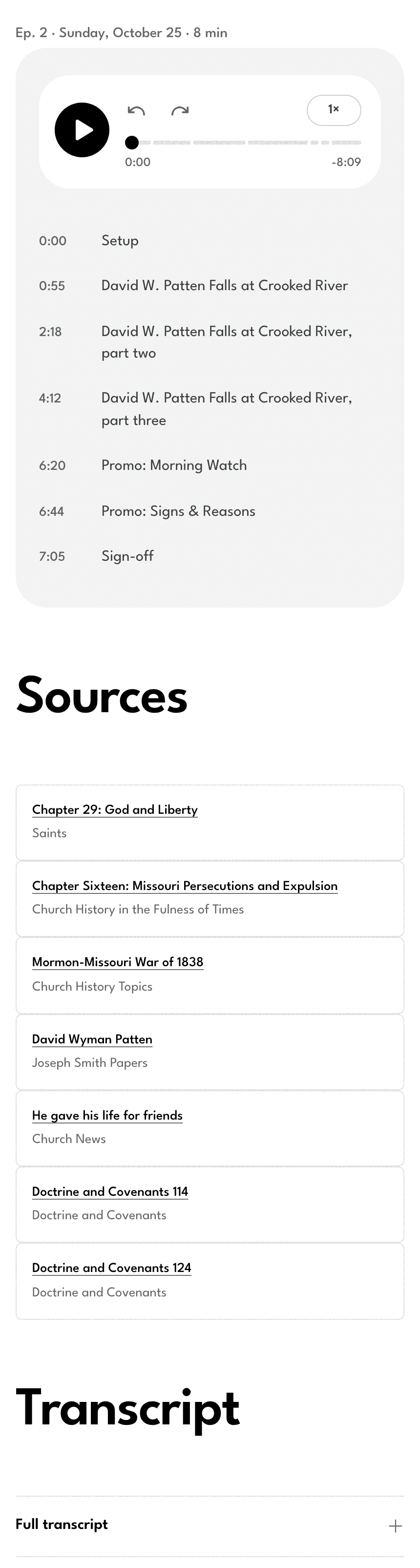
Player
The episode plays right on its page, and each show also has its own RSS feed for podcast apps.
Chapters
Every episode has chapters, from the setup through the promos for the other two shows and the sign-off.
Sources
Show notes list the episode's sources, each one a link.
Transcript
The full transcript sits on the same page.
Running it
The admin side is one planner calendar with a lane for each show, so I can see at a glance what is scheduled and what has aired. Downloads are counted through /listen/ redirects, which log the request and then send the listener on to the audio file, and the stats page shows totals per episode and per show. They are downloads and not plays, because podcast apps auto-download, and bots and my own listens are excluded from the totals.
What it taught me
The product decisions that mattered most were about where a model is allowed to write. Morning Watch is a neutral read that names its sources. The two solo shows are fact checked against a source I control. The disclosures and the promos are fixed text and assembled text, with no model in the loop at all. Each of those is a different answer to the same question of how much to trust the generation, and answering it per piece of copy, not once for the whole product, is what let me publish without reviewing every episode and still be comfortable with what goes out.
The voice work taught me to measure before decorating. Turn length and a pause that sounded like a dropout were real, fixable problems, and adding filler would have hidden them under the surface of speech. And moving to local voices took away the credit meter that had been quietly deciding how much I could make, which is what turned one show into three. I designed it and I built it end to end, from the voices to the planner to the feeds.